

Foreword:
This post is not about average Americans being at risk from the Andes Hantavirus. It’s about how ideology from current CDC leadership has finally become acquainted with reality.
Last night, The New York Times reported that an American currently at the National Quarantine Unit (NQU) in Omaha, Nebraska, was informed that she can’t leave.
The legal status of Americans like her—previously aboard the Andes hantavirus-afflicted MV Hondius cruise and now at the NQU—was on my mind last week. I asked a handful of officials a simple question: Was this quarantine voluntary?
I posed the question to administration officials. My MedPage Today colleague Kristina Fiore and I also asked officials at several state departments of health.
The answers we received surprised us. It wasn’t that the quarantines were voluntary. They weren’t even quarantines.
Everyone we heard from was quick to say that CDC guidance was being followed. And it was clear that the administration wanted the passengers to stay at the NQU in Omaha, for at least 72 hours, if not longer. But the avoidance of the word quarantine was conspicuous. When we used the word, we were explicitly corrected, on more than one occasion. The obsession bordered on creepy.
On a closer look, I noticed that the CDC’s Interim Guidance for Public Health Assessment and Management of People with Potential Exposure to Andes Virus only mentions the word quarantine once, and that was only in reference the National Quarantine Unit.
Instead of “quarantine,” even for high-risk contacts, the CDC guidance advised “monitoring with modified activities.” Moreover, passengers were told—falsely, it now appears—that they had the option of either home-based or facility-based management (either at the NQU or at an appropriate facility in a passenger’s home jurisdiction).

If quacks like a quarantine…
But what exactly did “monitoring with modified activities” mean? All of this was specified in a table, which is reproduced here:
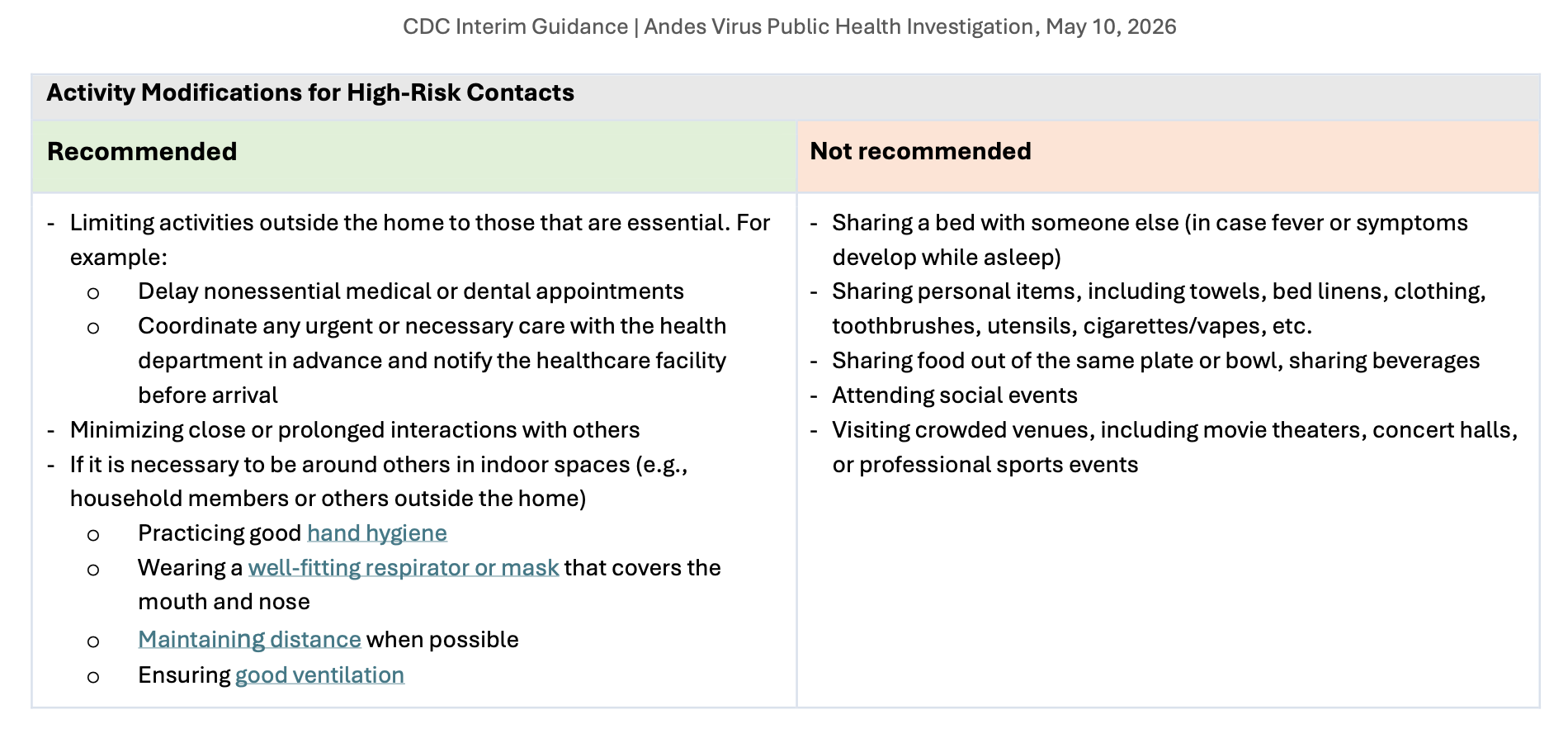
To me, this was quarantine in practice, if not in name.
Think about it.
The guideline recommends limiting activities outside the home to essential ones. By their reading, essential activities even excluded non-essential medical appointments. Additionally, any “urgent or necessary care” was to be coordinated with officials in advance. That is, they didn’t just want these people walking into clinics or hospitals. Basically, the only reason high-risk contacts were advised they should leave their homes was if they required emergency care—and even then, they needed to coordinate their movements with the healthcare facility in advance.
That sure sounds like a quarantine to me.
Is the National Quarantine Unit quarantining anyone?
And what about everyone else at the NQU? One of the passengers, a brave and likable travel photographer named Jake Rosmarin, has been hosting Instagram Lives from his 300 square foot quarantine unit. He told viewers over the weekend that he is not allowed to go outside. That didn’t make sense to me. If this was all voluntary, why couldn’t people get some fresh air, I wondered? The best explanation I could muster was that any passengers who had chosen the NQU had also agreed to play by its rules.
But that does not seem to be the case.
As The New York Times reported, one of the passengers at the NQU, Angela Perryman, was stopped from exercising her supposed option to leave and complete her quarantine “time away” from others at an AirBNB in Florida. She “and the 17 other passengers were told during a video conference call with federal officials that they had to remain at the unit voluntarily, or receive a mandatory quarantine order keeping them there.”
I’ve been reading the English language for over four decades. Allow me to leverage my expertise and say that this does not sound particularly voluntary to me.
Look, that’s fine. Maybe a small number of high-risk persons exposed to Andes hantavirus patients really do need strict quarantine in special facilities. That would be a reasonable stance for the CDC to have. But can this administration stop lying about what it’s doing for two seconds?
And really, that’s the root of this messaging debacle. The CDC’s current top official, Dr. Jay Bhattacharya, rode to celebrity (and eventually power) by opposing “lockdowns” during Covid-19. So for him to suddenly be issuing mandatory quarantine orders is, let us say, cognitively dissonant.
Golly, this is hard.
Again, it’s possible that the MV Hondius passengers should complete a 42-day quarantine. Beyond that, the question of how far the government should go in attempt to stop any of them from leaving a quarantine unit (or private home) is not an easy one. Should they physically stop a cruise passenger with a fever from attending Bingo night on day 10? What about an asymptomatic person on day 40? (Most cases declare well before then, but a few have taken longer in the past.) And how far should law enforcement go? Are we talking about blocking their movements into crowded places? Or are guns a-blazing?
It’s genuinely remarkable that we now have Brown University’s Dr. Jennifer Nuzzo telling The New York Times that home quarantine is probably fine, while literal Jay Bhattacharya is forcing people to stay in the National Quarantine Unit in Omaha. Bless this mess!
That said, I acknowledge that finding the right policy isn’t easy. But Dr. Jay Bhattacharya sure thought it was, back when he was a private citizen, advocating in October 2020 that the best course of action was to let Covid-19 infect millions of Americans, rather than waiting a few more weeks for news on vaccines.
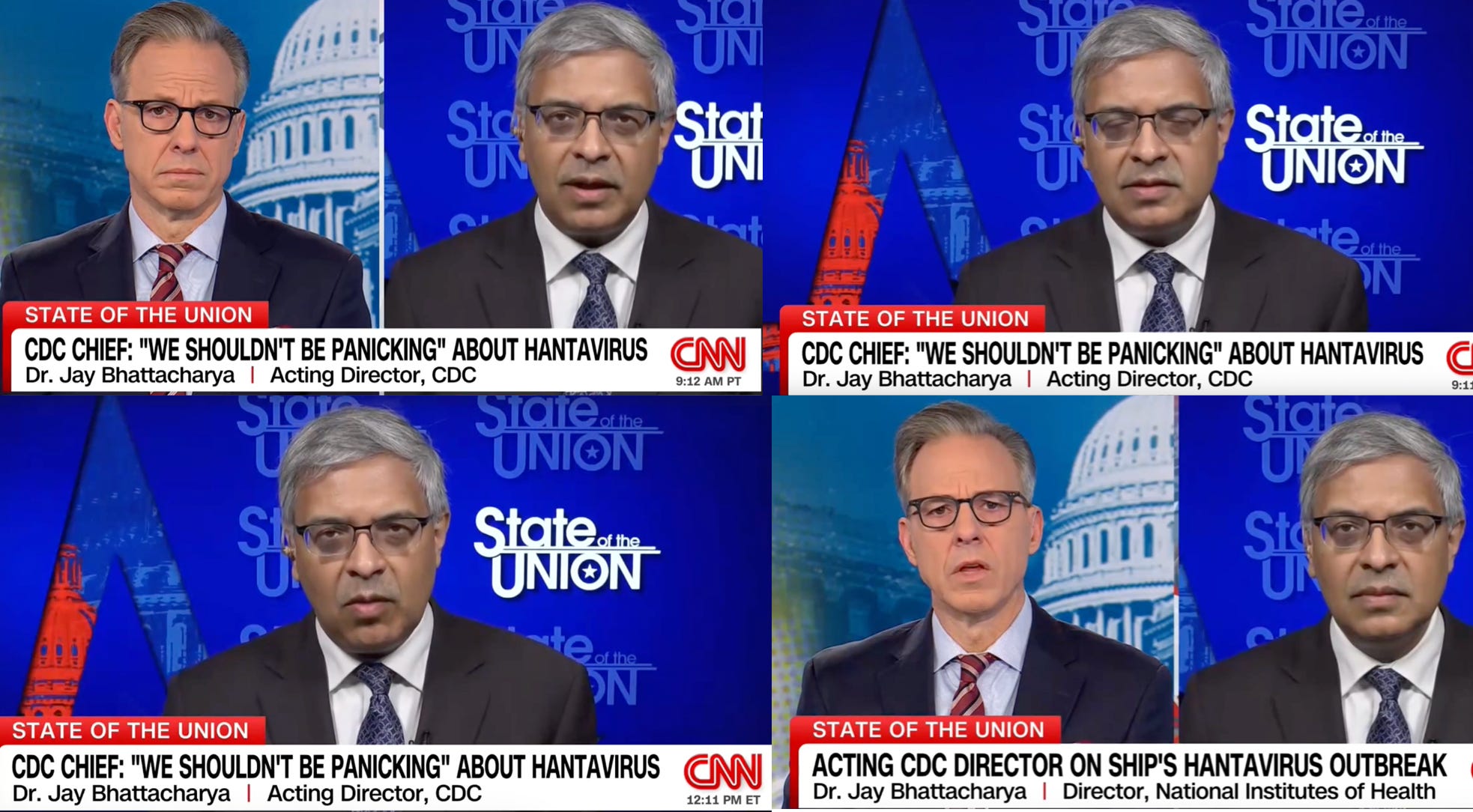
Moreover, he spent years criticizing CDC career professionals. But now that he's temporarily running the place, he suddenly got religion about the agency. Note in the clips below how he seems surprised that the CDC staff are professional—calling particular attention to the infectious disease experts. (And it’s not like the Trump administration brought in new people.)
In sum, Jay is now so impressed by the very people he spent years belittling. (He also overrode those exact scientists recently when he censored a Covid-19 vaccine paper led by agency scientists, but we digress.)
So, yes, I’d be tired too, if I were doing the cognitive backflips that must be required here. Jay spent years criticizing Dr. Anthony Fauci for the 6-feet rule during Covid-19 as unscientific (as if Dr. Fauci invented that). But now Jay is the one endorsing exactly that rubric as a feature of high-risk Andes hantavirus exposure.
In fact, he’s even adding new ones, including considering people to be high risk if they sat within two seats of an Andes hantavirus patient on a plane. Now, this policy seems to be based on influenza data. While I’m not sure how that applies to Andes hantavirus, it’s probably a reasonable guess. But what about the lavatory? If someone is shedding a lot of virus and they used the loo, that confined space could've exposed many more people than the proximate seat mates. Did anyone think of that? (No.)
A toxic ideology collides with reality.
My point is not to suggest one policy or oppose another. It’s to say that most responsible members of the public health community have enough humility to understand that in moments like this tough calls on minimal evidence must be made.
Nor am I saying all of this simply to dunk on Jay as a hypocrite. This is not about smugness or comeuppance. It’s about the long shadow of a toxic, prior ideology now standing in the way of current policy needs. If Jay had demonstrated some humility in 2020, he’d be having a much easier time implementing sensible policies now.
And really, that’s the problem. Jay—who has so much humility that it’s all he ever talks about—did not afford this same forbearance to his predecessors that he needs from the rest of us today. And now, because of that long trail of receipts, he clearly feels that he, of all people, can’t suddenly advocate for quarantines—not even for the extremely small group of people with high-risk Andes hantavirus exposures who probably warrant them.
That is why Dr. Jay Bhattacharya is not advocating for quarantines that will lock a few people down. He’s just going right ahead and imposing them.
Resources:
Hemorrhagic fever with renal syndrome hantavirus.
Thank you for reading! If you have information about any of the unfolding stories we are following, please email me or find me on Signal at InsideMedicine.88.
This is so well written that it gives me an anxiety attack! Just think about the mentalities now imposing their sort-of scientific (very "controlling") approach to what should be a collegial effort!
"If Jay had demonstrated some humility in 2020,"
OR, at ANY TIME in the past six years, admitted just how badly wrong he was in 2020. He was, remember, the senior author of that notorious preprint that came out on April 30, 2020 claiming the Infection Fatality Rate of SARS-CoV2 was comparable to seasonal influenza. At the time I instantly knew, when I read that preprint, that its IFR estimate was utterly implausible. As did many other experts at that time.