

For those of us of a certain age, adulthood began on precisely September 11, 2001. I’d been out of college for three months. I distinctly remember thinking that the horrors on our television screens could become a new normal—that more attacks might be coming. I was alert enough to understand that there would be a major military response. I remember wondering what kinds of sacrifices would be asked of us, my generation in particular. At age 22, I remember wondering if there would be a military draft—and saying to my mother that, all things equal, I would prefer not to be drafted, thank you very much, but that compulsory service in extreme circumstances was indeed “part of the social contract.” It quickly became clear, however, that the only patriotic act that most Americans were going to be asked to perform was to get back to normal life and keep the economy up and running.
If you’d told me then that 25 years later, there would not have been another mass-casualty attack on US soil organized by a foreign terrorist organization, I simply would not have believed it.
Of course, that wasn’t an accident or luck alone. According to a 2021 study from Brown University, the “War on Terror” cost the US around $8 trillion. (The study also found that the War on Terror claimed 905,000–940,000 lives—and possibly far more—though we have no way of knowing how many it may have saved.) While I’m not in a position to judge the success of the endeavor, it’s worth comparing that effort to what we spend on pandemic prevention. Keep in mind that the WHO estimates that, worldwide, there were nearly 15 million excess deaths associated with the Covid-19 pandemic from January 2020 through December 2021 alone. Given that, you’d think we’d invest a ton in pandemic preparedness and biodefense. Even in President Trump’s HHS, officials have recently said that we need to spend far more on medical countermeasures alone than we currently do. Just last month, an official at the Administration for Strategic Preparedness and Response (ASPR) wrote the following:
“$66.9 billion is needed over five years to build a well-developed preparedness portfolio across all priority threats; if funding stays flat at FY26 levels, that gap is projected at $33.5 billion over the same period. When the “worst day” does come — and we know it one day inevitably will — difficult conversations around this funding shortfall will inevitably follow.” —John Knox, Principal Deputy Assistant Secretary, Administration for Strategic Preparedness and Response.
If we spent what ASPR officials are recommending, we’d still probably (on average) only be spending $20 billion per year on biodefense and pandemic preparedness overall—that is, including spending at the CDC (and elsewhere in HHS), the Department of Defense, and the Department of Homeland Security. Over 20 years, that would amount to $400 billion, or just 5% of what we spent on post-9/11 wars.
Twenty-five years after 9/11, and six years after Covid-19 began, the investment contrast is remarkable. Last year, Congress appropriated $1 billion for the Strategic National Stockpile, which is critical infrastructure in the event of another public health emergency. That’s about the same amount of funding as the World Trade Center Health Program (WTCHP) received last year ($913 million, or $1.014 billion, depending on what you include.) As important as the WTCHP is—I’m not advocating for cuts to it—perhaps we should spend far more on preventing the next disaster, which could affect millions of people, than on addressing the consequences of the last one.
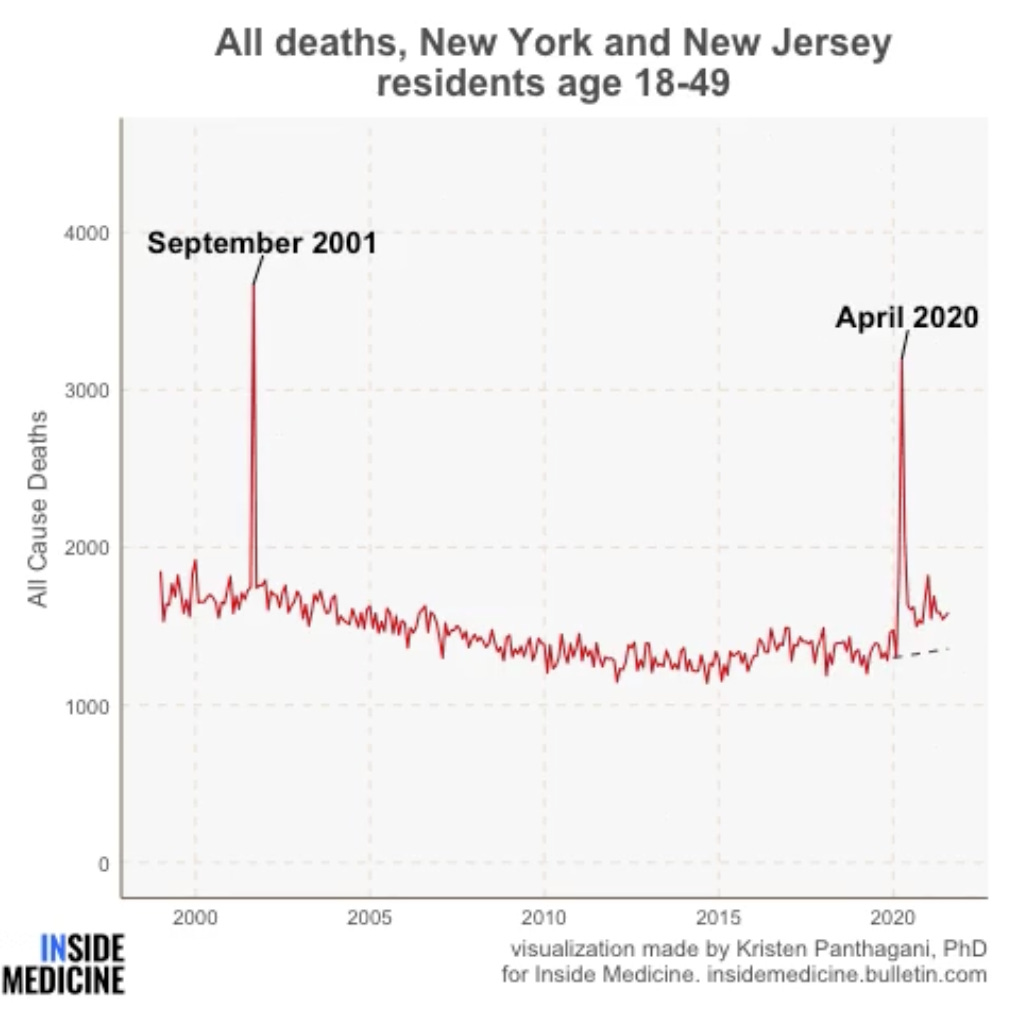
Below is an article I wrote about 9/11 here in Inside Medicine back in 2023. It includes one of the simplest, most powerful, and tragic data visualizations I’ve ever created (with the help of Dr. Kristen Panthagani). The piece ends with a call to use the anniversary of 9/11 as a reminder to make contributions to nonprofits that you believe in. I will do so today, and hope you will too.
9/11 and Covid-19: remembering two New York tragedies.
Jeremy Faust, SEP 11, 2023.
I moved to New York City in 2005 and lived there full time until 2016, with some commuting between Massachusetts from 2016 to 2018.
New York isn’t right for everyone. But, it was for me.
I am originally from San Francisco. I now live in Cambridge, Massachusetts (and love it here). But as most people who know me will tell you, I’m a New Yorker in my soul. I suspect I’ll always feel that way. It’s something about the pace and intensity of it, and its thrilling and bizarre diversity—if not the arts scene, which I devoured while living there.
New York is also where I learned to practice medicine. When they said “if you can make it there, you’ll make it anywhere,” they weren’t talking about emergency medicine specifically. But they sure could have been. It was an amazing place to learn this craft, and I was fortunate to be taught by some of the very best physician-educators out there.
So I have a confession: I have a bit of survivor’s guilt. I arrived in New York well after 9/11 and I left well before Covid. As a result of that timing, I never got to serve that community when it mattered the most. There’s nothing I could have done differently. That’s just what fate dictated. In particular, I truly wish I’d been there in March and April of 2020. (I had clinical shifts in Boston that I couldn’t possibly have skipped out on, but still, I somehow feel a pang of remorse about that…)
Today, on 9/11, I’m reposting a data visualization that Dr. Kristen Panthagani and I made two years ago. It shows how absolutely obscene the death counts from 9/11 and the first peak of Covid were in New York and New Jersey. What makes this graphic all the more tragic is the age group we chose to display. This is monthly all-cause mortality in New York and New Jersey among residents ages 18-49, from the turn of the century to 2020. It’s one of the most tragic things I’ve ever made.
The scale of what happened on 9/11 was so dreadful that this nation went to great lengths—some wise and some ultimately misguided—to prevent another such attack. That was the least we could do to honor the dead. I know those individuals would not have wanted anyone else to suffer such a fate. In that way, at least, we’ve had some success.
As we honor those killed on 9/11 by making and keeping our ports of travel safe, I hope we will someday go to the same lengths to limit other preventable deaths.
What can we do in the face of awful things? The great Mr. Rogers said, “When I was a boy and I would see scary things in the news, my mother would say to me, ‘Look for the helpers. You will always find people who are helping.’” It’s a wonderful sentiment, and good advice. In a 2020 essay, writer Elissa Strauss updated Mr. Rogers’ message, asking us to take it one step further. Yes, look for the helpers. But, whenever you can, be a helper.
9/11 has become a day of service for many people. I’m fortunate in that just by virtue of going to work in the ER later this afternoon, I’ll be doing something service-oriented. But it’s also my job, so, honestly, it just doesn’t count. Therefore, I’m also making a donation to a vetted organization helping with earthquake relief in Morocco. And they still need help in Maui. There’s probably something positive you’ve been meaning to do, whether with your actions or your wallet.
Let today be the day you get around to doing it. There’s always something we can do to help others. I hope 9/11 becomes a reminder of that.
Upgrade and support Inside Medicine.
“He’s very thoughtful and careful. He doesn’t just blast out against something; he gives it a fair evaluation and makes a helpful and useful comment. So he’s emerging as one of the most respected medical public health commentators.”
—Dr. Anthony Fauci
If you value independent reporting and analysis, please consider upgrading to a paid subscription. Your support makes Inside Medicine possible. Thanks!
So much said in a few words and a graph. Praying that the vast resources (scientific, intellectual and otherwise) we are fortunate to have access to are used to support and value life/quality of life. Thanks!
Bring Canadian I can never have the same visceral reaction nor emotional reaction to that moment frozen in time 25 yr's ago 😥
I joke about my new home in Newfoundland & call myself a 'landed immigrant' haha being born on the mainland.
My new family members & close friends have recently recanted stories of Newfoundlanders coming to the aid of someone in need.
Specifically, the community of Gander NL that came together & took in the 7,000 stranded passengers. This being only one of the hundreds of airplanes forced to divert from American airspace.
I fully acknowledge that there are also hundreds, if not thousands of times Americans have stepped in to aid their fellow neighbours.
I have no illusions that DJT will acknowledge the gracious welcoming the community of Gander extended to those stranded passengers. The American ambassador to Canada is present as a representative of USA.
This gentleman, however will offer hollow comments of appreciation for the hosts of those stranded on 9/11, given in recent weeks this same individual has repeated the nasty characterizations stated by DJT.
I have no doubts the vast majority of Americans appreciate the kindness bestowed upon their fellow citizens stranded on Sept 11th. Sadly, DJT will not sincerely express the same consideration.
The lasting tragedy of 9/11 is those who perished & their loved ones who will forever mourn their losses.
JJF Phm 🇨🇦 🙏 for those of die & survived