
There are now two CDC's.
Can the agency survive?

The last month was eventful. I want to catch you up on some things I’ve been doing, starting with an interview with Dr. Debra Houry, one of the top CDC officials who resigned in late August in protest of HHS Secretary Robert F. Kennedy Jr.’s firing of then-recently confirmed CDC Director. Before I share the interview though, I want to set it up with a brief reckoning of where things stand at the CDC. Folks, it ain’t pretty, but the agency is worth fighting to save.
Thanks for being here.
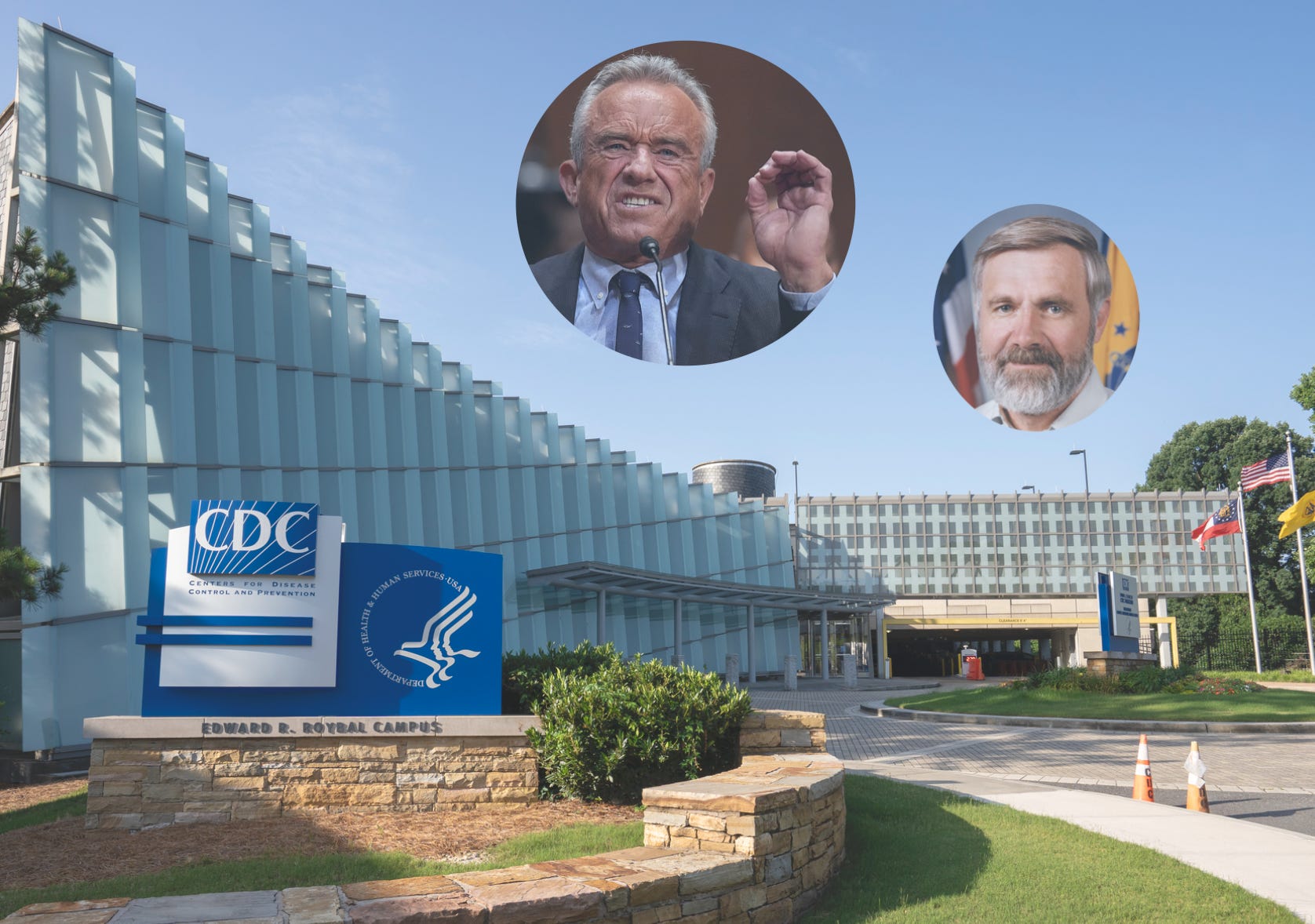
A “Coup de CDC.”
The CDC is now two distinct agencies—a house divided against itself. There are the career officers who continue to carry out the agency’s core mission. That’s the CDC of legends like Dr. William Foege, the former director who played a major role in eradicating smallpox. These dedicated federal employees may be hindered by cuts (and are still roiling from the August attack on their headquarters), but they are doing what they can to keep us safe. Then there’s a small coterie, a top brass gang of RFK Jr. allies, who control major policies, the agency’s public relations, and its social media.
In Senate testimony, former Chief Medical Officer Dr. Debra Houry, one of the top CDC officials who resigned last month, described the situation as a “hostile takeover.”
How is this manifesting? Most glaringly, the CDC’s Advisory Committee on Immunization Practices (ACIP), which met last month, voting on national policy without actually engaging in a review of the best evidence on the topics. Instead, the information presented was cherry-picked, out of context, and, frankly, amateurish at times.
The CDC also posted a truly bizarre new “priorities” statement, basically a political manifesto that included a typically Trump-world anti-DEI rant, among other random tangents, including one which came out against “harm reduction” for substance use disorders—the evidence-based approach that has saved lives. Meanwhile, the agency’s social media accounts posted anti-vaccine sentiments after its ACIP meeting.
Still, I’m still receiving some “normal” CDC communications in my inbox, including important announcements about drug-resistant bacteria.
So, now when we hear from the CDC, we have to ask “which CDC” is speaking?
Last month, I interviewed Dr. Houry for MedPage Today. It’s out as a three-part series. I encourage you to check it out.
Part 1: ‘Super Tough Decision’: Top CDC Official Reflects on Her Resignation. Former chief medical officer, Debra Houry, discusses leadership, science, and the attack on the CDC.
Part 2: U.S. May Not Be Ready for the Next Outbreak, Ex-CDC Official Says. “We were in a much better place up until about 7 or 8 months ago,” says Debra Houry
Part 3: ‘My Phone Started Blowing Up’: How CDC Leaders Learned of New Limits on COVID Shots. We were “not comfortable” implementing new guidance off a social media video, says Debra Houry.
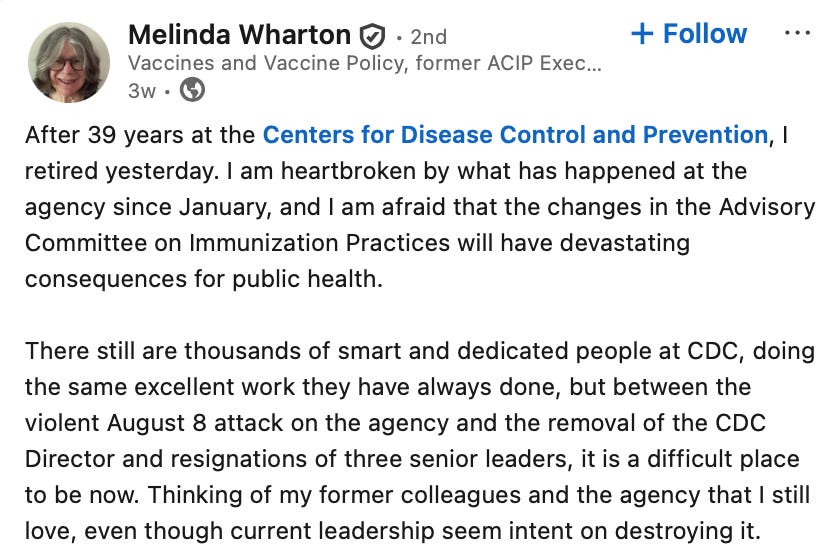
In the time since, we’ve seen more notable departures, including Dr. Melina Wharton, who spent nearly four decades at the CDC, after training at Harvard (MD) and Johns Hopkins (MPH in Epidemiology). Dr. Wharton served as the agency’s top official for ACIP. From all accounts, nobody understands the vaccine space better. These are the experts we are losing.
That’s why HHS employees have demanded that Secretary Kennedy resign. They are not alone. Dozens of expert medical societies have made similar statements. Until Kennedy is gone, or reined in, the CDC’s foundation is at risk of falling apart. Whether Congress cuts support for the agency by a little or a lot will also profoundly influence our nation’s health. Hopefully, Congress will eventually pass something closer to the Senate’s most recent proposal—which would only cut $100 million in funding to the CDC, bringing funding down from $9.2 billon to $9.1 billion. But if the House gets its way, $1.8 billion would vanish, bringing funding down to $7.4 billion. But even that would be better than President Trump’s proposal, which would cut CDC funding by $5 billion, down to $4.2 billion.
Odds and ends (some odder than others)…
Here are a few other recent stories I had a hand in, in one way or another.
Concerns over privatizing the military medical system.
Over at MedPage Today, Joedy McCreary wrote a story about a Trump official in the Pentagon best known to the medical field for having been CEO of Cerberus, a private equity firm that “drove all the [Stewart] hospitals into the ground.”
The present concern is the notion of privatizing the United States’ military health system. As my friend and colleague Dr. Art Kellerman said to me recently after publishing a piece in Forbes on this topic, the military medical system has a unique mandate: It must keep the nation’s military healthy and ready to deploy anywhere on the planet within 48 hours. That’s an awesome responsibility.
In 2024, military officials spoke out in opposition to privatizing the US military health system, announcing a reversal of some changes that had already taken place.
Data transparency on infectious diseases blocked.
In another MedPage Today story, Kristina Fiore wrote about CDC data scientists hitting a brick wall with the Trump administration over a project that would have made it easier for the public to track 127 infectious diseases known as “notifiable conditions”—that is, those which must be reported to the CDC, like anthrax or West Nile virus. So much for data transparency promised by the Trump administration.
HHS may try to blame Covid-19 vaccines for some pediatric deaths.
Last month, FDA officials mused publicly about pediatric deaths and Covid-19 vaccines. Apparently, some notion of a connection (which at present seems like a stretch, at best) might be elevated based on data in the Vaccine Adverse Event Reporting System (VAERS). The problem with using VAERS for such an endeavor is that the information entered into it are not subject to quality control. That is, anyone can make a claim that a vaccine caused a side effect, and that would show up in the database, even if there were not any real link. An FDA report on based on VAERS data would be the equivalent of making national policy after reading some angry Yelp reviews. Dr. Demetre Daskalakis, another of the major CDC officials who resigned last month, laid out the problems of this “adventure” in a thread on X/Twitter.
Follow up on RFK’s vaccine panels.
In early September, Inside Medicine was first to report that HHS Secretary Robert F. Kennedy Jr. sought to rush seven new members onto ACIP in time for its most recent meeting. By the time the meeting occurred, five of those seven had been officially installed. We don’t know what became of the other two Kennedy hopefuls. They’re either out (for reasons unknown), or will be installed by the next meeting, currently scheduled for later this fall.
Meanwhile, the FDA’s Vaccines and Related Biological Products Advisory Committee has lost Dr. Paul Offit, who was fired last month. That’s ironic, because Secretary Kennedy has railed about what he perceives as too much groupthink in these panels. Dr. Offit was the committee’s most independent voice, including having voted against some of the Covid-19 boosters (on the grounds that they were not sufficiently improved from the earlier versions, a principled, data-driven stance, it turns out.)
One last thing…
Misinformation resources.
As incorrect information increasingly comes from the federal government—lending credence to debunked rumors and pet theories of the anti-vaccine movement—I’ve been getting more requests for resources with high-quality information that can address these claims. While I obviously do some of that type of work here in Inside Medicine, there are experts who focus almost entirely on addressing these issues. Here are some resources you might like to have handy:
Unbiased Science has great information in a database of topics.
Here's a recent post in a blog called Diplomatic Immunity that tears apart some of the logical fallacies and misunderstandings that anti-vaxxers use.
Some of our vaunted institutions have information on frequently asked questions (often spurred by anti-vaxxers). Here are two from the Children's Hospital of Philadelphia, one of the nation’s most respected centers.
Vaccine ingredients in general.
Information about thimersosal.
If you have information about any of the unfolding stories we are following, please email me or find me on Signal at InsideMedicine.88.
Superb piece, Dr. Faust. The phrase “hostile takeover” hit the spot for me. That is exactly what this is, not a policy disagreement or a shift in priorities but a deliberate seizure of a public health institution by people hostile to science itself. Thank you for documenting it so clearly and giving voice to those who are still fighting to preserve the CDC’s integrity.
The problem is that too many people are not educated enough to understand what is happening. They are more able to accept superstition and lies than the truth because the lies are spoken in plain language. It’s horrendous how ignorant this country is compared to other nations. The rich and powerful prefer an ignorant population because ignorant people are more easily manipulated and controlled.