

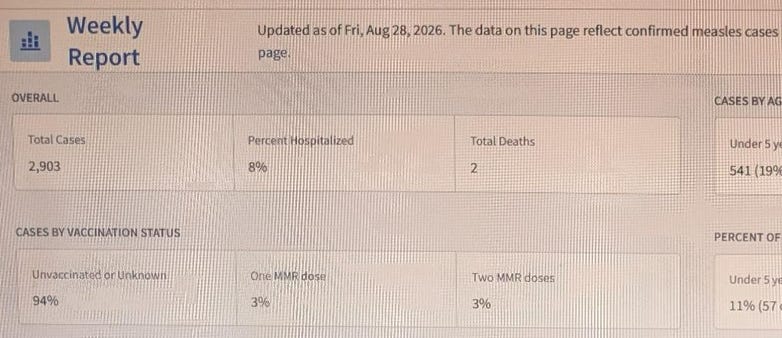
The CDC’s public messaging now contradicts its own internal data on measles deaths, Inside Medicine has learned. A screenshot of the CDC’s internal measles outbreak dashboard indicates that the agency itself continues to believe that the two deaths reported by Pennsylvania are indeed confirmed. Screenshots from the system were obtained by Inside Medicine and confirmed for authenticity by active CDC staff.
The data shown comes from an internal but widely accessible resource called One CDC Data Platform. The system is available to public health officials, including state and local officials, who contribute data to it. The CDC’s webpage says that “1CDP allows public health to better prepare for, detect, and respond to public health threats quickly.”
Last week, CDC Director Dr. Erica Schwartz instructed her staff not to include two measles-associated deaths reported by Pennsylvania. Today, Reuters reported that Secretary Robert F. Kennedy Jr. himself specifically asked Schwartz to exclude these deaths from the public-facing website, and that she took the order without question.
The CDC’s public website currently looks as follows:
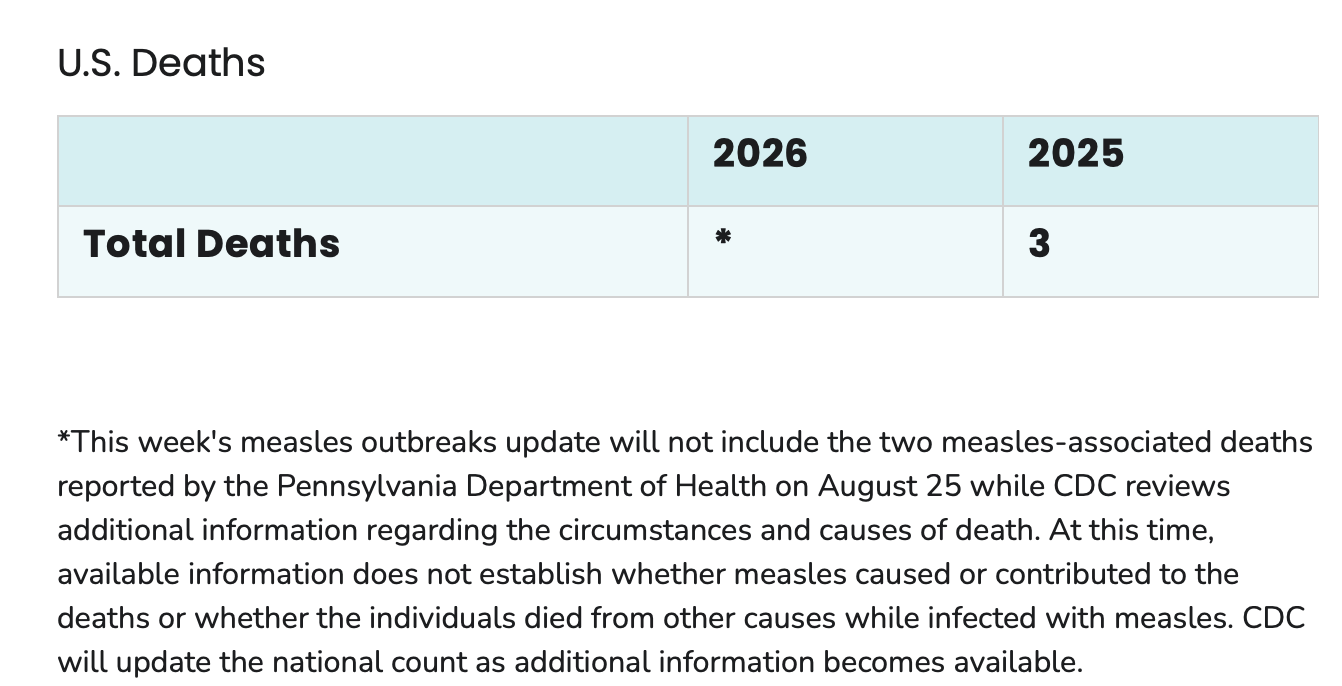
This means that the CDC’s public-facing data on measles deaths now contradict its own internal data. But the CDC’s internal website says otherwise, stating that the data “reflect confirmed measles cases reported to CDC as of noon on Thursdays and align with the data available on CDC’s external web.”1
In other words, the CDC’s epidemiologists and scientific officers continue to believe that these deaths are confirmed, and are neither provisional nor caveated in any way. This is in contrast to Secretary Kennedy’s public messaging and, now, that of the CDC Director herself.
Can we trust CDC data?
Every other piece of information on the internal measles dashboard is consistent with the CDC’s public-facing website. That includes case counts, hospitalizations, and information about the percentage of measles patients who are vaccinated. None of that is questioned. It is only the two deaths that Secretary Kennedy wants excluded from public tallies that are discrepant.
The implications of this are straightforward. If a public health agency is saying something different to the public than what it believes privately, that agency cannot genuinely be trusted. This is particularly unfortunate because a strength of the CDC in the past has been its data reliability. The CDC is not always lightning fast with reporting epidemiologic data, though that has improved dramatically in recent years. But when it does post data, it almost always gets it right and quickly corrects mistakes, once identified. Now, under Secretary Kennedy and CDC Director Dr. Erica Schwartz, even that can no longer be taken for granted.
Why upgrade to Inside Medicine?
“He’s very thoughtful and careful. He doesn’t just blast out against something; he gives it a fair evaluation and makes a helpful and useful comment. So he’s emerging as one of the most respected medical public health commentators.”
—Dr. Anthony Fauci
If you value independent reporting and analysis, please consider upgrading to a paid subscription. Your support makes Inside Medicine possible. Thanks!
Comments? Questions? Ideas? Venting? Please share your views in the Comments section.
Thank you for reading! If you have information about any of the unfolding stories we are following, please email me or find me on Signal at InsideMedicine.88.
Bolding added for emphasis.
Interestingly Jeremy, I note that the RIGHT and the LEFT are now united in their utter contempt for and distrust of our government.
Sadly, myself and other readers and subscribers are not surprised with the "two faces" of the CDC & HHS. 😥
Congratulations, on the solid acknowledgement & complimentary praise from Dr. Anthony Fauci 👍😊
JJF Phm 🇨🇦